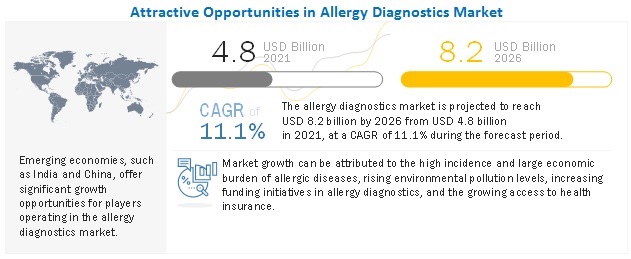
The Research Report on "Allergy Diagnostics Market by Product & Service (Consumables, Instruments (Immunoassay Analyzer, ELISA Analyzer, Luminometer), Service), Allergen (Food, Inhaled, Drug), Test Type (In Vivo, In Vitro), End User (Diagnostic Laboratories) - Global Forecast to 2026" published by MarketsandMarkets, is projected to reach USD 8.2 billion by 2026 from USD 4.8 billion in 2021, at a CAGR of 11.1% from 2021 to 2026.
Growth Drivers : Rising environmental pollution levels;
Exposure to indoor and outdoor air pollutants, allergens, and occupational exposure are the major risk factors causing chronic respiratory diseases. The prevalence of allergic disorders among the urban population is higher than those living in rural areas due to the higher exposure to environmental pollutants in cities (as a result of vehicular pollution and industrial activities).
As per the WHO, more than 80% of people living in urban areas are exposed to air quality levels that exceed the WHO safety limits; though this is a global trend, its effects are more severe in the urban areas of low-income countries. This is a major indicator for the growth of the allergy diagnostics market, as air pollution from motor vehicles has been indicated as one of the major risk factors responsible for allergic diseases.
Epidemiological and toxicological research reveals a causal relationship between air pollution and the increased incidence of asthma, allergic rhinitis, and other allergic disorders. Studies have also demonstrated a significant increase in the incidence and exacerbation of asthma in urban locations with elevated PM 2.5 (particulate matter of size 2.5 micrometers or less), nitrogen dioxide, and ozone concentrations.
Download PDF Brochure: https://www.marketsandmarkets.com/pdfdownloadNew.asp?id=232871701
Industry Segmentation In Detailed:
“Consumables are expected to hold the largest share of the allergy diagnostics market”
Based on product & service, segmented into consumables, instruments, and services. In 2020, the consumables segment accounted for the largest share of the allergy diagnostics market. The large share of the consumables segment can be attributed to the increasing cases of allergies and the need for rapid tests to diagnose allergic conditions. The consumables segment is also expected to witness significant growth during the forecast period.
“In vivo tests are expected to hold the largest share of the allergy diagnostics market”
Based on test type, segmented into in vivo tests and in vitro tests. In 2020, the in vivo tests segment accounted for the largest share of the allergy diagnostics market. The growth of this segment is mainly driven by the increasing adoption of various in vivo tests, such as skin prick tests. These tests are dependable, safe, convenient, and cost-effective, as compared to in vitro tests.
“Inhaled allergens are expected to hold the largest share of the allergy diagnostics market”
Based on allergens, segmented into inhaled allergens, food allergens, drug allergens, and other allergens. In 2020, the inhaled allergens segment accounted for the largest share of the allergy diagnostics market due to the increasing environmental pollution and rising pollen coupled with other factors such as fungus, mold, and dust.
Request Sample Pages: https://www.marketsandmarkets.com/requestsampleNew.asp?id=232871701
Leading Key Players and Analysis:
The major players operating in Allergy Diagnostics Market are Thermo Fisher Scientific Inc., (US), Siemens Healthineers (Germany), Danaher (US), Omega Diagnostics Group PLC (UK), bioMérieux SA (France), Romer Labs Division Holding (Austria), EUROIMMUN Medizinische Labordiagnostika AG (Germany), HollisterStier Allergy (US), NEOGEN Corporation (US), Eurofins Scientific (Luxembourg), Minaris Medical America, Inc. (US), Stallergenes Greer (UK), HOB Biotech Group Corp., Ltd. (China), HYCOR Biomedical (US), R-Biopharm AG (Germany), AESKU.GROUP GmbH (Germany), ACON Laboratories, Inc. (US), Lincoln Diagnostics, Inc. (US), Astra Biotech GmbH (Germany), and Erba Group (UK).
Thermo Fisher Scientific Inc., a US-based company, is the leading player in the allergy diagnostics market, accounting for a share of 14.6% in 2020. The company’s strong position in the market can be primarily attributed to its product portfolio. Phadia instruments offered by the company are extensively used by laboratories and other healthcare settings for allergy testing. Besides, the company also has a strong geographic presence, which is the main factor for the company’s strong customer base. The company serves more than 400,000 customers in pharmaceutical and biotech companies, hospitals and clinical diagnostic labs, universities, research institutions and government agencies, as well as environmental, industrial quality and process control settings.
Geographical Analysis in Detailed:
“North America commanded the largest share of the allergy diagnostics market in 2021.”
The allergy diagnostic market is segmented into North America, Europe, Asia Pacific, Latin America, and the Middle East & Africa. In 2020, North America commanded the largest share of the allergy diagnostics market. The large share of North America can be attributed to the rising incidence of allergies, favorable reimbursement scenarios for allergy diagnosis, and the availability of supportive initiatives by associations.
Speak to Analyst: https://www.marketsandmarkets.com/speaktoanalystNew.asp?id=232871701

