Market Research, Market Size, Market Research Report, Market Share, Market Analysis, Market Growth,

Showing posts with label Depth Filtration Market Size. Show all posts

Tuesday, April 9, 2019

Global Depth Filtration Market Revenue, Demand, Opportunity, Segment and Key Trends 2019

The Growth of Depth Filtration Market is propelled by the increasing demand for biopharmaceuticals and increasing R&D expenditure in the biopharmaceutical industry.
On the other hand, stringent government regulations are expected to restrain the growth of this market to a certain extent during the forecast period. In addition, the low capacity of depth filters in high-density harvest is the major challenge in the Depth Filtration Market.
provides a detailed overview of major drivers, restraints, challenges, opportunities, current market trends and strategies impacting the global market along with estimates and forecast of revenue.
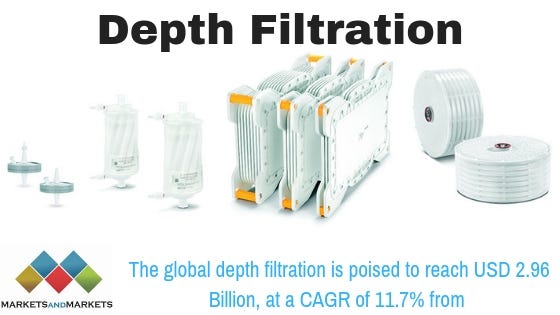
The Global Depth Filtration Market is poised to reach USD 2.96 Billion, at a CAGR of 11.7%.
Download PDF Brochure:
The Global Depth Filtration Market research report categorizes the market on the basis of media type, product, application, and region.
based on application broadly classified into final product processing, cell clarification, raw material filtration, and other applications (such as water purification and viral clearance). The final product processing segment is further divided into small molecule processing and biologics processing. Similarly, the raw material filtration segment is further categorized into media & buffer filtration and bioburden testing.
Depth Filtration Market Growth Drivers;
· Growth in the Production of Biologics and Large Molecules
· Increasing R&D Expenditure in Pharmaceutical and Biopharmaceutical Companies
· Advantages Such as Low Cost and Ease of Use are Driving the Uptake of Depth Filters
· merging Markets Offer Lucrative Growth Opportunities
Geographical Analysis:
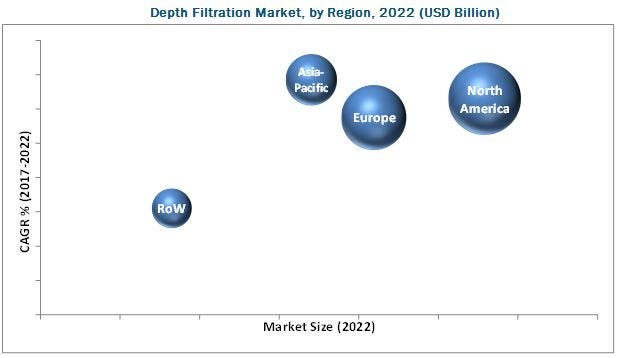
North America (comprising the U.S. and Canada) is expected to account for the largest share of the global Depth Filtration Market, followed by Europe. North America is the world’s largest pharmaceutical market and a leader in biopharmaceutical research. Rising quality requirements have emphasized the need for advanced bioproduction technology in this region. Asia-Pacific is expected to grow at the highest CAGR in the forecast period.
  • Further breakdown of the APAC Depth Filtration Market into China, Japan, India, and Rest of Asia-Pacific
  • Further breakdown of the European Depth Filtration Market into Germany, France, the U.K., and Rest of Europe
Some of the Major Key Players Operating in the Market;
The Depth Filtration Market is dominated by established players such as Merck KGaA (Germany), Sartorius Stedim Biotech S.A. (France), and Pall Corporation (U.S.).
Speak to Our Subject Expert:
Merck Millipore KGaA (Germany) was one of the leading players offering depth filter cartridges. The company has strengthened its position in the market through the adoption of organic as well as inorganic strategies such as expansions and acquisitions. Between 2015 and 2017, the company acquired companies to complement its product portfolio and expand its reach. For instance, in 2015, Merck KGaA acquired Sigma Aldrich (U.S.). With this acquisition, the company enhanced its product range & capabilities and expanded its geographic reach & customer base.

Tuesday, March 12, 2019

Depth Filtration Market 2019 – Global Industry Size, Share, Analysis, Trend & Future Strategic Planning

The Research Report on Depth Filtration Market provides a detailed overview of major drivers, restraints, challenges, opportunities, current market trends and strategies impacting the global market along with estimates and forecast of revenue.
The growth in this market will majorly be driven by the increasing production of biologics and large molecules, as depth filtration plays a significant role in providing pure and quality products.
Download PDF Brochure:
Depth filters offer advantages such as low cost and ease of use; these advantages are driving their uptake in the market. However, the low capacity of depth filters for high-density harvest is a key challenge in this market.
The growth of this market is propelled by the increasing demand for biopharmaceuticals and increasing R&D expenditure in the biopharmaceutical industry. Emerging markets such as Asia-Pacific provide new growth opportunities for players in the market.
The research report segments this Depth Filtration Market-based media type, product, application, and region
Depth Filtration Market Based on Media Type;
On the basis of media type, the depth filtration market is segmented into diatomaceous earth, activated carbon, cellulose, and perlite. In 2017, the diatomaceous earth filters segment is expected to account for the largest share of the depth filtration market followed by activated carbon. This high share is attributed to its high-quality filtration and the wide range of applications in the pharmaceutical and biopharmaceutical industry.
Request Free Sample Pages:
Depth Filtration Market Based on Application;
based on application, the depth filtration market is categorized into final product processing, cell clarification, raw material filtration, and other applications. final product processing segment is expected to account the largest share of the global depth filtration market.
The final product processing segmented is further divided into small molecule processing and biologics processing. The large share of the final product processing segment is attributed to the rapid growth in the biopharmaceutical industry, expansion in generics production, and the need for high-quality final products.

Friday, December 7, 2018

Depth Filtration Market Growth and Analysis, Industry Trends, Size, Shares, Forecast

The Global Depth Filtration Market is poised to reach USD 2.96 Billion by 2022 from USD 1.70 Billion in 2017, at a CAGR of 11.7%.


Browse 71 market data Tables and 29 Figures spread through 127 Pages and in-depth TOC on “Depth Filtration Market”
The report provides a detailed overview of major drivers, restraints, challenges, opportunities, current market trends and strategies impacting the global market along with estimates and forecast of revenue.
The growth in this market will majorly be driven by the increasing production of biologics and large molecules, as depth filtration plays a significant role in providing pure and quality products. Depth filters offer advantages such as low cost and ease of use; these advantages are driving their uptake in the market. However, low capacity of depth filters for high-density harvest is a key challenge in this market.
Furthermore, based on application, the depth filtration market is categorized into final product processing, cell clarification, raw material filtration, and other applications. In 2017, final product processing segment is expected to account the largest share of the global depth filtration market. The final product processing segmented is further divided into small molecule processing and biologics processing. The large share of the final product processing segment is attributed to the rapid growth in the biopharmaceutical industry, expansion in generics production, and the need for high-quality final products.
North America (comprising the U.S. and Canada) is expected to account for the largest share of the global depth filtration market in 2017, followed by Europe. North America is the world’s largest pharmaceutical market and a leader in biopharmaceutical research. Rising quality requirements have emphasized the need for advanced bioproduction technology in this region. Asia-Pacific is expected to grow at the highest CAGR in the forecast period. Significant investments by key market players, increasing government support, developing R&D infrastructure, and growing expertise and academic excellence are the major factors fueling the growth of the depth filtration market in the Asia-Pacific region.
The depth filtration market is dominated by established players such as Merck KGaA (Germany), Sartorius Stedim Biotech S.A. (France), and Pall Corporation (U.S.).